
Engineering Precision for Reliable Charging Infrastructure
Reliable EV charging begins inside the station, where circuit boards coordinate power delivery, protection, measurement and communication. These assemblies must perform consistently through repeated charging sessions and demanding operating conditions. P&C Enterprise Solutions (PCES) combines electronics design, hardware and firmware development, precision assembly and customized testing, offering a manufacturing foundation for customers developing EV charging equipment.
AC charging equipment manages the safe supply of AC power to the vehicle’s onboard charger, with functions such as control-pilot signaling, contactor control, metering and fault detection. DC fast chargers additionally incorporate off-board power conversion, typically involving power-factor correction and DC/DC stages, with accurate voltage and current control. Board requirements therefore vary significantly between control, communication, sensing and power-conversion assemblies.
Electrical safety and thermal performance must guide the design. Insulation coordination, creepage and clearance, isolated sensing and fault-response paths require careful evaluation. Power assemblies also demand attention to current paths, switching-loop layout, heat dissipation and component derating. These decisions must reflect working voltage, environmental exposure and applicable product standards, rather than a universal spacing or temperature rule.
PCES’s integrated design services cover electronics, software, structural design, component selection, prototyping and reliability engineering, including thermal considerations. Applied to an EV charger project, these capabilities provide a basis for coordinating schematic design, PCB layout, firmware and mechanical interfaces. Early design-for-manufacture and design-for-test reviews can identify assembly constraints and required test access before production. The specific power rating, protection architecture and validation scope should be established with the customer.
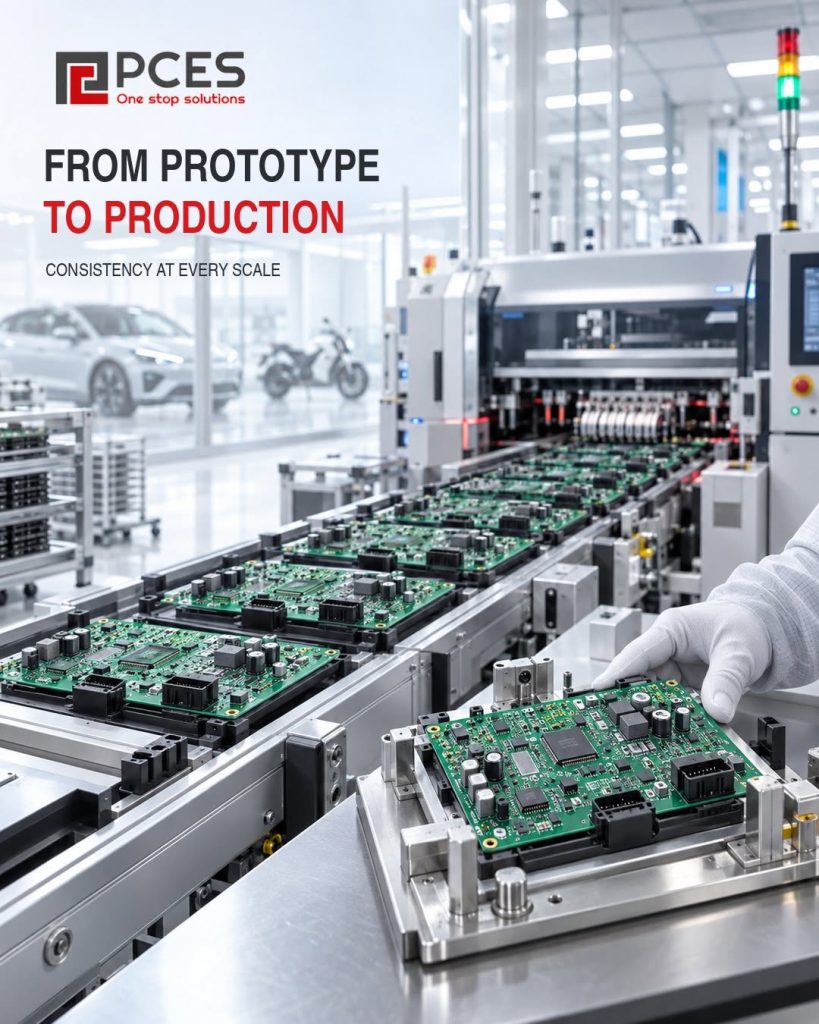
Quality and consistency in production are key factors that determine the quality of the final product. PCES’s production system uses Yamaha’s most advanced equipment lines, combined with strict inspection processes including SPI, AOI 2D AOI 3D, X-ray inspection, ICT, FCT equipments. These technologies work together to create a production line that meets even the toughest manufacturing requirements.
PCES offers in-circuit testing, customized functional fixtures, hardware and firmware adaptation, parallel programming and flying probe testing options.
In addition, outdoor operation introduces moisture and contamination risks. PCES’s conformal-coating line and potting services offer protection options for appropriately designed assemblies. Material selection, cleanliness, coating coverage, curing and connector keep-out zones must be controlled. Protective coating complements insulation and enclosure design.
Through its “One stop solutions” approach, PCES brings design, assembly, inspection, testing and protective processes into one coordinated partnership. Contact PCES to discuss your EV charger’s board architecture, operating conditions and verification requirements, and develop a manufacturing plan aligned with your product.
Meet us at ELECTRONICA 2026. Booth #265 Space #A1
November 10-13, 2026 | Trade Fair Center Messe München
Am Messesee 2, 81829 Munich, Germany