
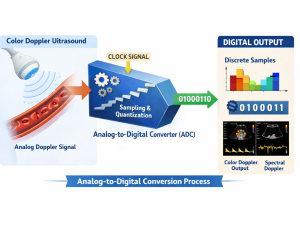
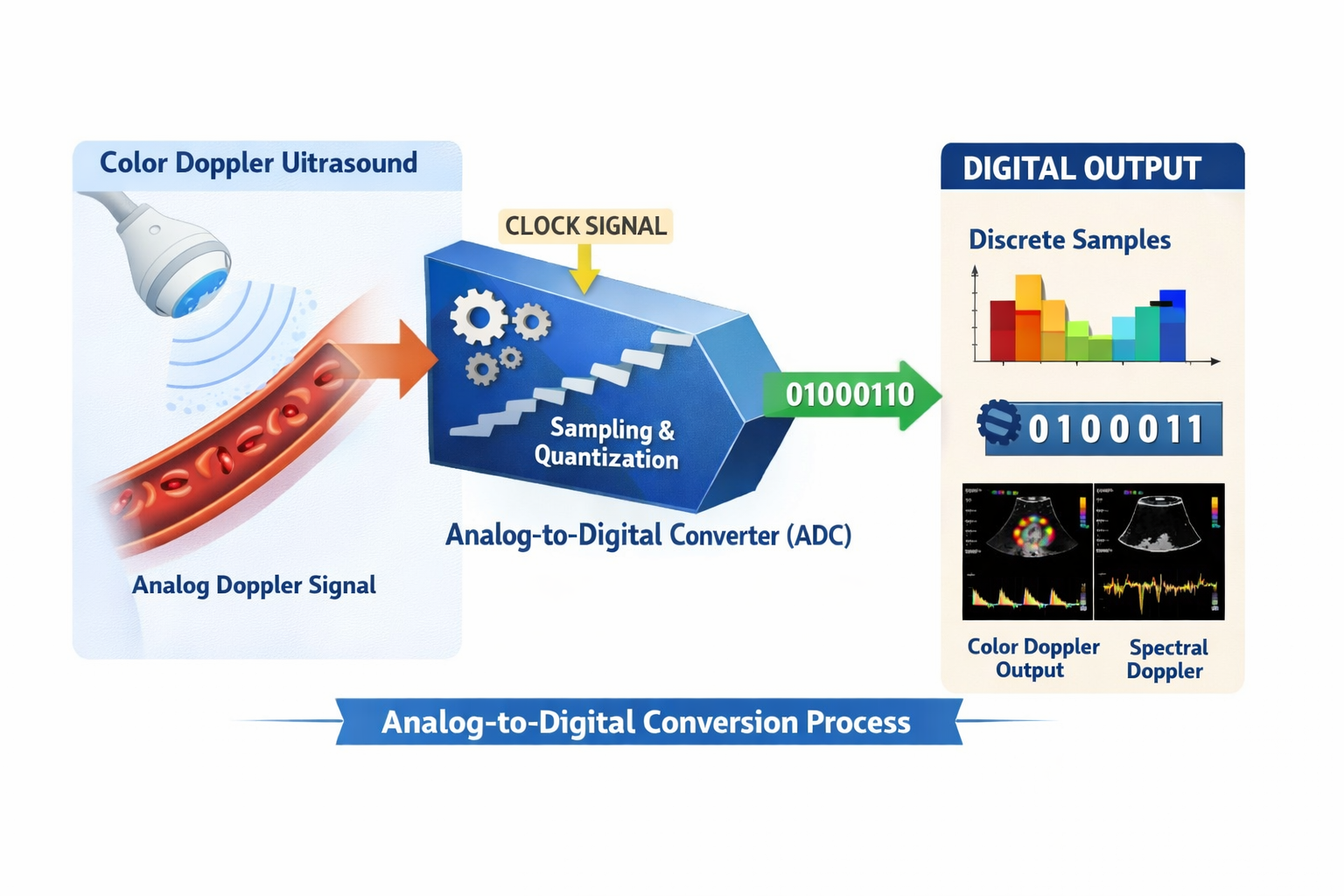
Overview of the Role of ADC in Color Doppler Systems
In a Doppler ultrasound system, the signal received from the probe is an analog signal with very small amplitude, typically in the MHz range. This signal carries information about blood flow velocity and direction through the Doppler effect.
The ADC performs three core functions:
The performance of the ADC directly impacts:
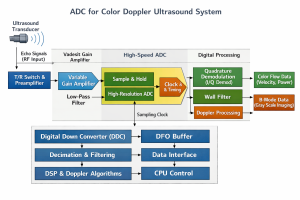
Detailed Structure of ADC Components
1. Analog Front-End (AFE)
This is the pre-processing stage before the ADC and is critically important.
Low Noise Amplifier (LNA)
Poor design at this stage will significantly degrade the overall system SNR.
Variable Gain Amplifier (VGA)
This is essential for maintaining uniform image quality across different depths.
Anti-aliasing Filter (AAF)
This is a common design pitfall if not properly implemented or if the cutoff frequency is incorrectly selected.
2. Sample and Hold (S/H)
Technical requirements:
Jitter performance is critical in Doppler systems as it directly affects frequency accuracy.
3. Core ADC Architecture
Depending on the design, different ADC architectures can be used:
Pipeline ADC (most common)
Best suited for Doppler ultrasound applications.
SAR ADC
Sigma-Delta ADC
4. Quantizer & Encoder
Higher resolution provides greater dynamic range
5. Clock System
Requirements:
6. Digital Interface
In modern systems:
Critical Considerations in ADC Board Design and Manufacturing
1. PCB Layout – Determines 50% of Success
Key principles:
A poor layout can result in a 20–30 dB loss in SNR.
2. Power Supply Design
Power noise is one of the primary causes of jitter and distortion.
3. EMI/EMC Compliance
Medical devices must meet strict standards:
4. Thermal Management
Temperature variations directly affect ADC drift and accuracy.
5. Calibration & Matching
Even small mismatches can lead to incorrect blood flow velocity measurements.
6. Component Selection
Typical ADC vendors include:
Selection criteria:
 Analog-to-Digital Converter (ADC)




Reviews
There are no reviews yet