

Company News
The Full-Function SMT Line – The Backbone of Modern Electronics
The Surface Mount Technology (SMT) line is the technological heart of modern electronics assembly. It is a highly automated, sequential process designed for the high-speed placement and soldering of miniature electronic components onto a Printed Circuit Board (PCB). For those knowledgeable in this domain, understanding the function of each station and, critically, the impact of equipment quality is paramount to achieving high yield and long-term product reliability.
Architecture of a Full-Function SMT Line
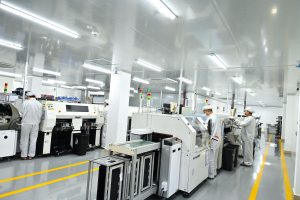
A comprehensive SMT line is not merely a collection of machines but a tightly integrated system comprising six essential stages, each connected by automated conveyors
This is arguably the most critical stage, responsible for laying the foundation of the solder joint.
- Equipment: Automatic Solder Paste Printer (Screen Printer).
- Function: Applies a precise volume of solder paste onto the PCB pads through a metal stencil using a squeegee mechanism.
- Quality Reliance: Printer alignment accuracy (X, Y, θ) and squeegee pressure control are fundamental. A poor printer leads directly to volume defects (insufficient, excessive, or offset paste), which account for the majority of reflow defects.
2. Solder Paste Inspection (SPI)
The first in-line quality gate, positioned immediately after printing.
- Equipment: 3D Solder Paste Inspection (SPI) Machine.
- Function: Uses structured light and triangulation to measure the volume, height, and area of every paste deposit. It provides a real-time, quantitative analysis of printing quality.
- Quality Reliance: High-speed, high-accuracy 3D measurement is non-negotiable. Quality SPI provides crucial feedback data to the printer, enabling closed-loop control and preventing a mass of defective boards from moving down the line.
3. High-Speed Component Placement
The core of the SMT line where components are mounted.
- Equipment: High-Speed Pick-and-Place (PnP) Machines (often two or more in series).
- Function: Accurately picks components from feeders and places them onto the pasted PCB. The first machine often handles high-volume, small passives (chips), while the second (sometimes called the “Flexible Placer”) handles larger, complex ICs and connectors.
- Quality Reliance: Placement accuracy (down to 25μm for fine-pitch BGAs), nozzle/feeder reliability, and vision system speed determine throughput and placement yield. A high-quality PnP machine minimizes placement errors (misalignment, missing components, polarity issues).
4. Reflow Soldering
The process where the electrical and mechanical bond is formed.
- Equipment: Forced Air Convection Reflow Oven (often 8 to 12 heating zones plus a cooling zone).
- Function: Executes the precise thermal profile (preheat, soak, reflow, cool) required to activate the flux, melt the solder paste, and form the final metallurgical joint.
- Quality Reliance: Zone temperature uniformity, thermal profile repeatability, and reliable forced convection (often under a Nitrogen atmosphere to reduce oxidation/dross) are vital. A superior oven ensures consistent Time Above Liquidus (TAL) across the entire board, preventing defects like tombstoning or cold joints.
5. Automated Optical Inspection (AOI)
The final electronic eye that verifies assembly quality.
- Equipment: 3D Automated Optical Inspection (AOI) Machine.
- Function: Inspects the completed assembly post-reflow. Uses 3D triangulation and 2D color imaging to detect defects such as component presence/absence, polarity, misalignment, and critical solder joint issues (shorts, insufficient solder, lifted leads).
- Quality Reliance: High-resolution 3D imaging is superior for inspecting the complex geometry of solder fillets and verifying coplanarity, which a 2D system cannot reliably measure. A high-quality AOI system minimizes both false calls (unnecessary rework) and escapes (undetected defects).
6. Auxiliary & Support Equipment
These components ensure efficiency and traceability:
- Conveyors: Automate material flow.
- Loaders/Unloaders: Manage PCB magazines at the start and end of the line.
- Barcode Readers: Critical for Product Traceability and verifying the correct program is run.
- Component Counter: (Often an X-Ray counter) to maintain accurate inventory.
The Indispensable Link Between Machine Quality and Product Quality
In PCBA manufacturing, the quality of the equipment is not just an operational cost; it is the primary determinant of final product reliability and operational throughput.
- Repeatability and Accuracy: Lower-quality machines suffer from poor long-term repeatability. A premium PnP machine maintains its accuracy tolerance over millions of cycles, ensuring consistently centered and level placement. Cheaper machines drift, introducing random placement errors that necessitate higher inspection and rework rates. The failure of a machine to maintain its precision (e.g., poor printer alignment) creates systematic defects, meaning a high percentage of all boards produced during that shift may be compromised.
- Process Control: High-end equipment integrates sophisticated sensors and control loops (e.g., in ovens and printers). A quality SPI machine enables the crucial closed-loop feedback that corrects printing errors before the component is committed. Without this, a manufacturer is simply inspecting defects rather than preventing them.
- Total Cost of Ownership (TCO): While the initial investment in high-quality equipment is significant, the long-term TCO is lower. High-quality lines minimize costly rework, reduce material waste (from scrapped PCBs), and maximize Overall Equipment Effectiveness (OEE) by reducing unexpected downtime and improving yield.
As an industry leader in PCBA manufacturing, P&C focuses on investing in high-end, well-maintained SMT equipment as the most effective strategy to ensure and maintain product quality.
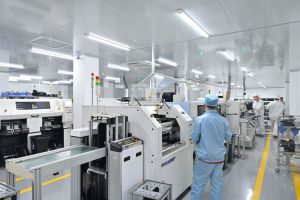
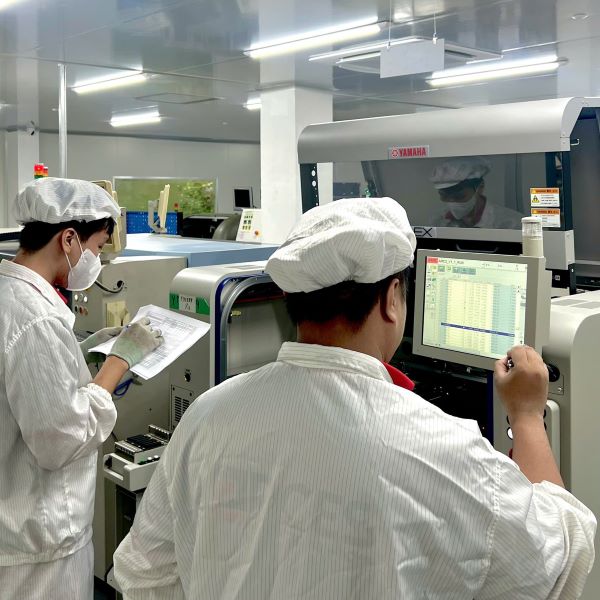
At P&C factory, we are equipped with modern automatic productions and assembly lines from reputable manufacturers. We are committed to ensuring that we meet the most stringent technical requirements of our customers.
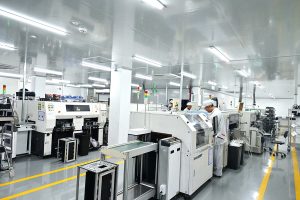
- Quality & Traceability System: Yamaha IT system, AIT, Dashboard
- Solder Paste Printer: Yamaha YRP10e, GKG G5, DEX NeoHorizon 03iX
- 3D Solder Paste Inspection Machine: Yamaha YSi-SP
- SMT Mounter: Yamaha YSM20, Yamaha YG200, Panasonic AM100
- 2D & 3D AOI Machine: Yamaha YSi-V, Marker Ray S400
- Reflow Curing Oven: JT RS-800II, Heller 1809 EXL
- Radial Component Insertion: Panasonic NM-RA20A
- Axial Sequencer Machine: Sciencgo XG-4000
- Wave Soldering: JT NK-350 II
- Selective Wave Soldering: J-PAK JP-J-001
- Conformal Coating Line: Axxon AC500D
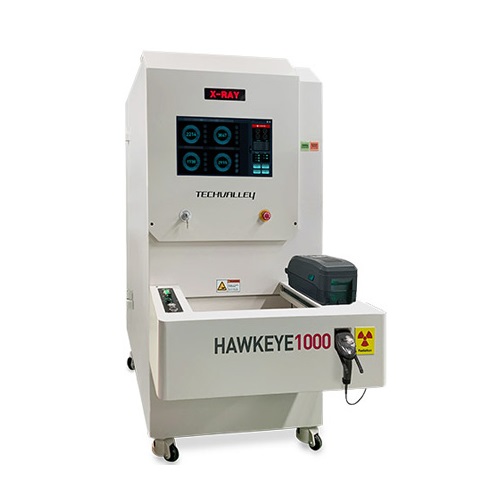
- X-Ray 3D inspection & Counter: TechValley Arirang1000

Source: PCES
X-Ray Component Counter Technology in PCBA Assembly
X-Ray Component Counter technology is an essential tool in modern Printed Circuit Board Assembly (PCBA) factories, moving component inventory management from manual estimates to high-precision automation. This non-contact inspection system utilizes low-dose X-rays to quickly and accurately count the number of electronic components sealed within their tape-and-reel packaging.
The Operational Principle
The X-Ray counter operates on the principle of differential X-ray absorption. Electronic components, particularly integrated circuits (ICs), transistors, and passive devices, are constructed using materials of varying density (silicon, copper, ceramic, metals). These materials absorb X-rays differently than the surrounding packaging materials (plastic or paper tape, plastic reel).
- X-Ray Emission: A focused, low-dose X-ray beam is directed at the component reel. The beam penetrates the packaging material.
- Absorption and Attenuation: The dense component materials attenuate (absorb) more of the X-ray energy than the less-dense tape.
- Detector Array: A flat-panel detector array (similar to those used in digital radiography) captures the X-ray energy that successfully passes through the reel.
- Image Processing: The captured image shows the components as distinct, darker shadows against the lighter background of the tape. Sophisticated image recognition software and algorithms analyze the image pattern to identify each individual component pocket and count the contents.
This process provides a precise, non-destructive count of the components, usually completing the scan in a matter of seconds.
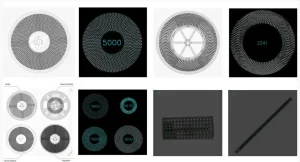
Key Applications and Benefits
The primary value of X-Ray counting is the prevention of errors and downtime in the high-speed SMT assembly line:
- Real-Time Inventory Accuracy
Manual counting is time-consuming and error-prone. The X-Ray counter provides an immediate and verifiable count, ensuring the Enterprise Resource Planning (ERP) and Material Requirements Planning (MRP) systems have accurate inventory data. This is crucial for “just-in-time” manufacturing environments.
- Feeder Setup Verification
Before an SMT Pick-and-Place machine starts a job, the operator must load component feeders. X-Ray counting is used to confirm that the reel loaded onto the feeder contains the required minimum number of components to complete the job, preventing a costly “running out of material” (ROM) stop midway through the assembly process.
- Small Component Counting
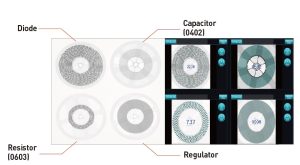
Counting ultra-small passive components (like 01005 or 0201 chip resistors/capacitors) is virtually impossible manually. The high resolution of the X-ray system makes these miniature components easily countable, ensuring accurate stock levels for the smallest, highest-volume parts.
- Traceability and Quality Control
Advanced systems can integrate the component count, part number, and reel barcode into a central database, improving traceability. If a reel is returned to the warehouse, the count is instantly updated, maintaining data integrity.
Integration into the Smart Factory
X-Ray component counters often feature automatic reel loading/unloading and robotic integration, fitting seamlessly into the Industry 4.0 vision of the smart factory. By eliminating material shortages and reducing the time spent on manual counting, this technology significantly boosts the overall Overall Equipment Effectiveness (OEE) of the SMT production line
P&C Enterprise Solutions (PCES) is a trusted OEM/ODM electronics manufacturer based in Vietnam. Our electronic components and embedded solutions have been delivered to customers across Europe, Asia, and the Middle East, supporting a wide range of industries including audio systems, GPS devices, elevators, lighting, and automation. With strong in-house capabilities in product design, hardware, firmware, and mass production, we provide fully customized solutions tailored to your specific project requirements.
P&C owns the HAWKEYE1000 X-Ray Component Counter, which is the latest generation model from the manufacturer TechValley.
Source: PCES